Providing legally-required information to employees can be a confusing maze for employers to navigate. It’s easy to conflate the notice requirements between posters and individual notices, especially since the information they provide often overlaps.
Regardless, workplace posters and employee notices serve different purposes, apply at different times, and are enforced differently, so it’s important for employers to understand the difference and provide employees with information correctly.
What are workplace posters?
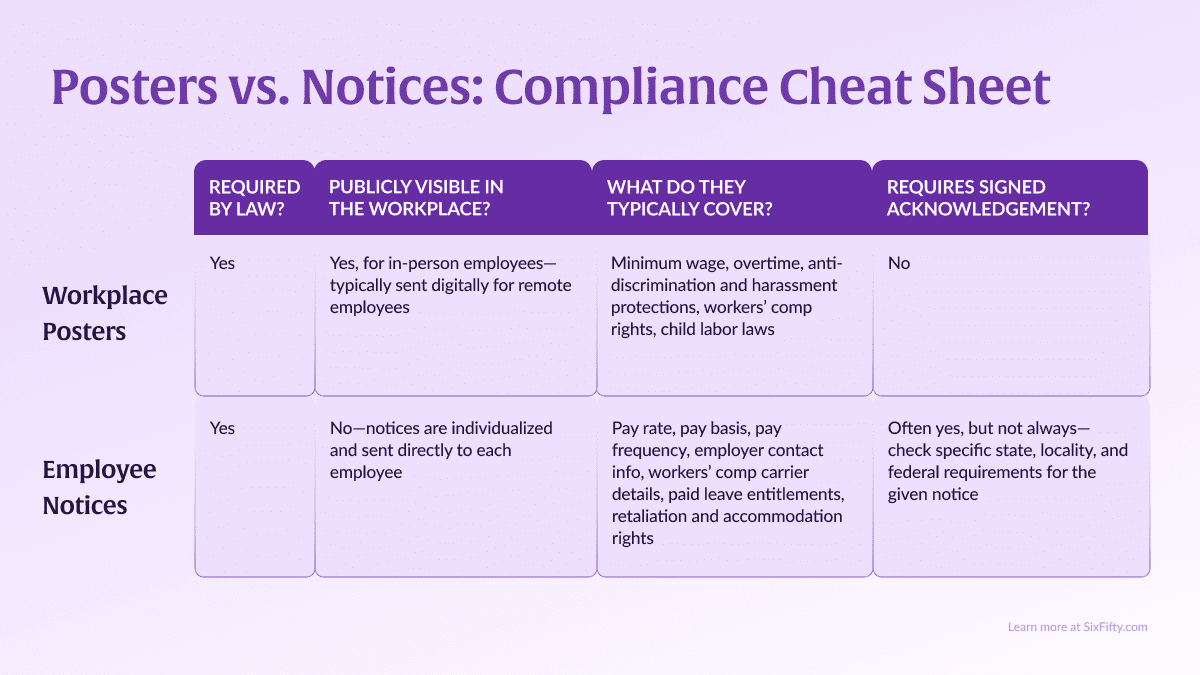
Workplace posters are generalized notices that employers must display in a location where employees can easily read them. These posters typically communicate employees’ rights under federal, state, or local law.
Posters commonly cover topics like:
- Minimum wage and overtime
- Anti-discrimination and harassment protections
- Workers’ compensation rights
- Child labor laws
Characteristics of workplace posters
- Timing: Workplace posters must be posted continuously.
- Format: Posters are typically physical, or in some cases, approved electronic postings.
- Location: Posters must be posted to break rooms, near time clocks, or other common areas. For remote employees, posters should be digitally accessible, either via direct email or through the employer’s intranet.
If a poster is missing, outdated, or not placed where employees can easily read it, offending employers can be subject to penalties, regardless of employees’ actual knowledge of their rights.
What are employee notices?
Employee notices are individualized disclosures that must be provided directly to employees, usually at the start of employment, when certain job details change, or annually, depending on the notice.
Employee notices often include:
- Pay rate and pay basis (hourly, salary, commission)
- Payday frequency
- Employer contact information
- Workers’ compensation carrier details
- Paid leave entitlements
- Retaliation and accommodation rights
Characteristics of employee notices
- Timing: Notices are provided at hire, onboarding, upon a triggering event (e.g., pay changes or pregnancy), or annually.
- Format: Notices are sent via paper or electronic delivery, often with acknowledgment.
- Content: Employee-specific information is often included, though not always.
Unlike posters, employee notices are not satisfied by general availability. Employers must actually deliver the notice to each employee and, in many cases, obtain a signed acknowledgement of receipt from the employee.
Practical compliance tips for posters and notices
To stay compliant:
- Track both obligations separately. Keep note of poster requirements and notice requirements independently.
- Watch for updates. Poster content and notice language can change with new laws or regulations. Some posters like minimum wage may be updated annually.
- Be aware of local laws. Cities and counties often impose additional posting or notice rules. These requirements stack on top of federal and state requirements.
- Record notice delivery. Keep records showing when and how notices were provided. For notices that require a signed acknowledgment, keep the acknowledgment in a place it can be found, like the employee’s personnel file.
- Consider remote employees. Electronic posting and notice delivery rules may apply differently for distributed workforces. States have yet to fully consider the notice process for remote employees but following the US Department of Labor’s guidance is a safe practice.
Tools for tracking legal changes to poster and notice requirements
Think of workplace posters as ongoing, public disclosures, and employee notices as individual, targeted communications. Both are essential, but treating them as interchangeable is one of the easiest ways for employers to fall out of compliance.
At SixFifty, we understand that you need your time to run your business, not track minute-to-minute updates in the law.
To help employers stay on top of their posting obligations, we have created a Posters module that allows you to provide the most current posters to your employees, either electronically or as a physical poster. We track state movement and as soon as we learn of a change, we update our posters and alert you to the change. All you need to do is open your notification and allow the update—no more constant review and second-guessing.
SixFifty also has all required employee notices for federal law, D.C. law, each state in our Research platform. Individual notices need employee-specific information, so just select your state, review the list of notices, then download and send them, collecting acknowledgments where applicable.
Get started with SixFifty today and eliminate employee notice compliance risk.